


Incoterms: clear agreements on your global transport
Van Thiel Transport advises on the conditions best suited to your transport needs
Incoterms (International Commercial Terms) offer globally recognised agreements around international transport. By including an Incoterm in your transport agreement, it is clear to everyone who arranges the transport, pays the costs and bears the transport risks. This provides certainty and avoids ambiguity about your rights and obligations, during or after the transport.
Van Thiel Transport helps you determine which Incoterm best suits your international transport needs. Contact us now for expert advice from our staff. On business days, you receive a response within an hour on average.
Incoterms 2020 provide clarity on who bears what responsibilities
Incoterms are drawn up by the ICC (International Chamber of Commerce). Every 10 years, the Incoterms are revised. The latest list from 2020 includes 11 Incoterms. Each Incoterm describes a set of agreements around transport. These agreements consist of:
Who arranges transport?
This part of the Incoterm defines which party (buyer or seller) is responsible for arranging the transport. This includes the means of transport, but also any additional logistics issues, such as transport insurance and customs clearance.
Who pays the costs?
The Incoterm describes who pays what transport costs. These are the direct costs of transport, but also additional costs, such as insurance and any import duties.
Who bears the risks?
The Incoterm defines which party bears the transport risks. Risks may include damage to goods, or loss of goods in transit.
What is the place of transfer?
Besides defining responsibilities using an Incoterm, it is important to define a place where responsibilities are transferred to the other party. This place could be, for example, a port, a means of transport, a warehouse or a border.
Expert advice on the right Incoterm for every transport
You don’t want any surprises during or after your transport. It is therefore important to always take a critical look at which Incoterm best applies to your transport. Van Thiel Transport staff are versed in the details of Incoterms. They will advise you so that you can export and/or import your goods with peace of mind at all times.
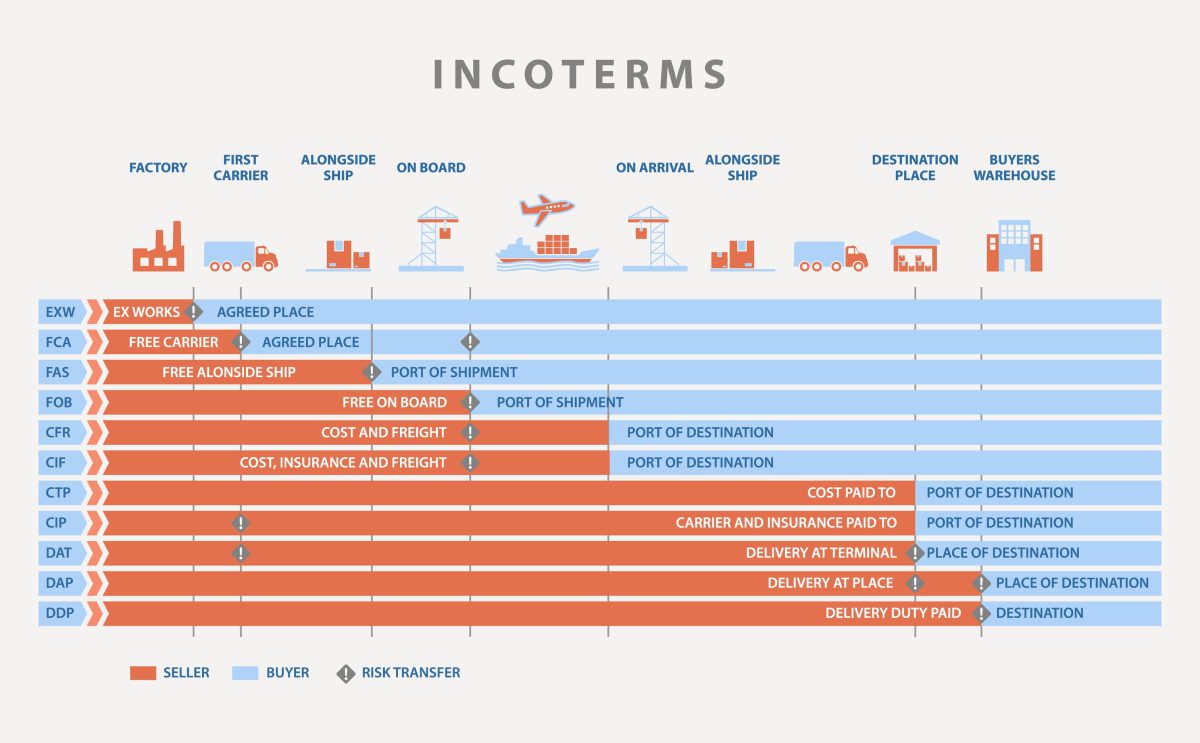
Four of the 11 Incoterms are specifically for sea freight:
- CFR – Cost and Freight
- FOB – Free On Board
- FAS – Free Alongside Ship
- CIF – Cost Insurance and Freight
The remaining seven are there for other modes of transport:
- EXW – Ex Works
- FCA – Free Carrier
- CPT – Carriage Paid To
- CIP – Carriage and Insurance Paid To
- DAP – Delivered At Place
- DPU – Delivered At Place Unloaded
- DDP – Delivery Duty Paid
Besides the means of transport, other things also play a role in determining the right Incoterm. This can be the transport type, such as FTL/FCL and LTL/LCL. Whether the goods cross the European border also matters.
Depending on the conditions agreed with the Incoterm, Van Thiel Transport will calculate the rate for your transport.

"*" indicates required fields
Frequently asked questions about Incoterms
Do you have questions about Incoterms? Many of the questions we often receive have been answered below. Is your question not listed here? Please contact us, our staff will be happy to inform you further.
Incoterms (International Commercial Terms) are international agreements that specify who is responsible for the transport, costs, and risks associated with international shipments. They provide clarity between buyer and seller and prevent misunderstandings about, for example, who pays the freight or arranges insurance.
The right Incoterm for sea freight from China depends on your logistics preferences and the level of control you want:
- FOB (Free On Board) gives you more control over costs and scheduling.
- CIF (Cost, Insurance & Freight) is more convenient if your supplier wants to arrange transport.
Van Thiel Transport will personally help you choose the Incoterm that best suits your import from China.
No, Incoterms are not legally required, but they are used worldwide as a standard for international trade. By using Incoterms, you avoid conflicts, misunderstandings, and unexpected costs during the transport process. We therefore strongly recommend using them.
Yes, absolutely. The specialists at Van Thiel Transport are happy to advise you on the correct Incoterm based on your goods, destinations, and logistics needs. This way, you avoid surprises and know exactly what to expect.
- EXW (Ex Works): The seller makes the goods available; you arrange and pay for the entire transport yourself.
- FOB (Free On Board): The seller delivers the goods on board the ship in China; after that, the risk is transferred to you as the buyer.
- CIF (Cost, Insurance & Freight): The seller pays the transport costs up to the port in Rotterdam, for example, including insurance, but the risk transfers as soon as the goods are on board.
Van Thiel Transport is happy to advise you on which option best suits your delivery conditions.
Van Thiel Transport clearly records all agreements in the transport documents and checks that all parties involved use the same Incoterm. This prevents misunderstandings, delays, and additional costs.
If something goes wrong, Van Thiel Transport immediately assesses who is responsible according to the chosen Incoterm. We then help you resolve the problem as quickly as possible and work with you to find a practical solution, even if it falls outside our direct responsibility. Our priority is always to complete your shipment quickly and accurately.
Yes, that’s possible. Van Thiel Transport offers a complete transport package: from Incoterm agreements and customs clearance to all necessary export documentation. This gives you a single point of contact for all your international transport needs.
Yes, Incoterms can be adjusted as long as both parties agree to the change. Van Thiel Transport helps you correctly record the new agreements in the documents and communications, ensuring the adjustment is legally and administratively sound.
You benefit from clear agreements, reduced risks, and a smooth transport process. Thanks to our experience with international trade and customs formalities, Van Thiel Transport ensures that your shipment proceeds smoothly according to the correct Incoterm.
The right Incoterm depends on who has the most control, experience, and resources: you or your supplier. Factors such as costs, risks, and logistics expertise play a role. Van Thiel Transport helps you step-by-step in determining the best Incoterm for your situation.
Incoterms determine who is responsible for transport, insurance, and risks along the way. This way, you know exactly whether you or your Chinese supplier will pay the transport costs and who is liable for damage or delays.
Are you responsible yourself (such as with EXW or FOB)? Then you arrange the transport, insurance, and any import duties. Van Thiel Transport can take care of all these steps for you, so you don’t run any risks or miss any important steps.
Van Thiel Transport checks your Incoterm selection, clearly documents all agreements, and maintains close contact with the supplier, freight forwarder, and recipient. This prevents documentation errors, delays, or additional costs, ensuring a smooth delivery.
Is your question not answered?
Our employees will be happy to help you, so please feel free to contact us.